
Inmate Lookup provides instant access to Greenville County correctional records, letting you search by name, ID number, or booking number from any device. The online portal displays inmate identification, custody classification, facility assignment and detention status, while also showing record update dates. Users can verify inmate information quickly, compare personal identifiers, and confirm the correct inmate record even when similar names appear in the database.
Inmate Lookup also helps you troubleshoot common issues such as no results or duplicate records. By checking the record last update and matching personal identifiers, you can identify why an inmate lookup shows no results or why multiple inmate records share a name. The system flags restricted or archived information, guiding you to the appropriate contact for record verification and correction when needed.
How to Search Inmate Lookup
Inmate Lookup for Greenville County starts with the county’s official search page. Use the page to find a custody record by name, inmate ID number, or booking number, then compare each result with the details you have. Users can also check greenville county sc for official county government information. A listed record can show inmate identification, custody classification, facility assignment, detention status, and its last update date. This process helps you find the correct record and spot details that need county staff review.
Official Search Portal: https://greenvillecountysc.gov/disclaimer/InmateSearch.aspx
Steps to Search
- Open the official county link. The greenvillecountysc.gov address places the page on Greenville County’s government website. Read any disclaimer, search terms, or privacy notice shown on the page before beginning your search.
- Find the inmate search fields. Look for a name field and any choices for inmate ID number or booking number. If the portal separates search types, select the type that matches the number you have.
- Choose the strongest identifier available. An inmate ID number can give the most direct result. A booking number can also work when it comes from the source that created the booking. If neither number is available, use the person’s full legal name.
- Enter the details exactly as they appear on the source. Remove extra spaces, keep every digit in an ID or booking number, and use the name format shown on the most recent official document. Do not mix a court case number with a booking number.
- Submit the search and wait for the results. If the page offers more than one result, review each entry instead of choosing the first name match. A common name can belong to more than one custody record.
- Open the matching result and review the listed fields. Check the inmate name, inmate ID number, booking number, custody classification, facility assignment, detention status, and record update date. Some entries may show only certain fields.
- Compare the result with your source before relying on it. Look for agreement across several personal identifiers, not just the name. If a key value conflicts, note the exact field and the value shown on each source.
- Keep a record of the search terms, result, and update date you used. These details make it easier to repeat the search later or explain a possible error to county staff without relying on a third-party profile.
Inmate Lookup Methods
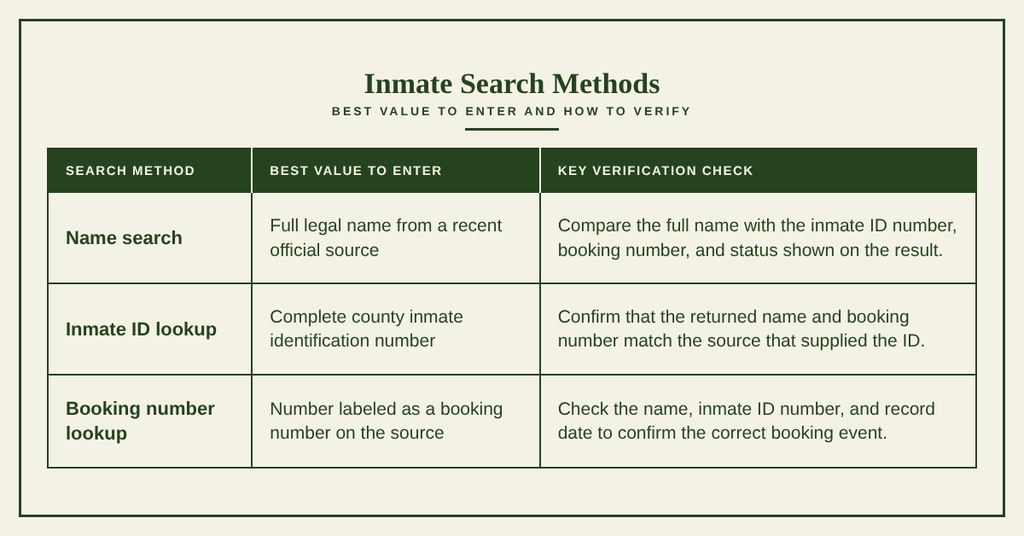
The right search method depends on the identifier you already have. An ID number or booking number can narrow the result more than a common name, while a name search helps you locate a record when no number is available. Each method still needs a record-by-record check before you accept the result.
Search by Name
An inmate lookup by name works best when you enter the person’s full legal name as it appears on the most recent official document. Search the exact spelling first, including any middle name shown on the source. A shared name does not prove that two records belong to the same person, so review all matches and compare their identifiers.
Search by Inmate ID Number
An inmate ID lookup gives a direct route when a county-issued inmate identification number is available. Enter the complete number without dropping letters, spaces, or digits. Compare the returned name and booking number with your source, since a number copied from an unrelated court case may not lead to the custody record you want.
Search by Booking Number
A booking number lookup can locate the record connected to a particular intake event. A person can have more than one booking and receive a different number for each event, so the booking number should match the source you are checking. A court docket number serves a different purpose and should not be used in its place.
Verifying Record Accuracy
Record verification means checking that a search result belongs to the person you mean and reflects the custody event you need. It also means judging how current the result appears to be. Name matching, identifier matching, record status, and the update date work together because one field can miss a conflict or create a false match.
Comparing Personal Identifiers
Personal identifiers are details that help distinguish one custody record from another. Compare every field the portal shows with your source, then note both matches and conflicts. A strong check uses several details that point to the same record instead of relying on a shared name.
Use a Layered Identity Check
A four-part check works well when both the result and your source provide the needed fields. Match the full name, inmate ID number, booking number, and date of birth if the portal displays it. Do not treat a field as a required search term unless the form asks for that value, and stop before accepting a result when major identifiers disagree.
- Compare the full legal name. Treat a minor formatting difference, such as a hyphen or shortened middle name, as a point to check rather than an automatic mismatch.
- Compare the complete inmate ID number. Do not rely on a partial number or a number that appears in a different record type.
- Compare the booking number. A match can confirm that the result points to the same intake event recorded on your source.
- Compare the date of birth if it appears. A conflict calls for a closer review and confirmation from county staff.
- Use facility assignment and detention status as supporting signs. These fields can help separate active records, yet they do not replace personal identifier checks.
Checking the Record Last Update Date
The record last update date shows when the portal refreshed that entry. It does not act as a live movement alert, release notice, or court hearing time. Treat it as the date attached to the displayed record. An older date calls for extra care because facility assignment and detention status can change after the last refresh.
Read the Date in Context
Compare the update date with the date on your source and with the status wording in the result. If your source is newer, the portal may not yet contain the newest event. If the portal is newer, check that the names and identifiers still agree. The date alone cannot show which field received a recent review.
- Use a recent update date with matching identifiers as support for the listed status.
- Treat an older active-status entry as a dated snapshot rather than proof of present custody.
- Compare the date with any move, release, or court date on your source.
- Record an unclear or missing date as a point for county staff to check.
Record Availability and Restrictions
The Greenville County inmate search covers records within the county custody system. It does not replace a complete court case file, a federal inmate system, or a record held by another local jail. You can also consult arrest lookup to locate official filings. What appears online can depend on record status, legal restrictions, and whether the entry is active or historical.
Publicly Viewable Inmate Records
The online roster can present a limited public profile of a county custody record. Official search details may include inmate identification, custody classification, facility assignment, detention status, and the record update date. A booking number may also appear or serve as a search reference. Treat these fields as a snapshot of custody information rather than a complete case history. The inmate name is the name stored with the county custody record. Compare the full name and use an identification number or booking number to confirm the correct entry. An inmate ID number is a county identifier that distinguishes custody records, while a booking number refers to a particular booking event. Match these numbers with the booking document and the returned inmate name whenever possible.
Custody classification identifies the category assigned to a person’s custody record. Use it to understand the record’s context rather than as proof of specific charges or a court outcome. Facility assignment identifies the facility associated with the record at the time of the recorded update. Compare this information with your source and check the date before treating it as the person’s current location. Detention status reflects the custody status listed in the portal at the time of its latest update. Check for a later release, transfer, or other change before relying on the information. The record update date indicates when the entry was most recently refreshed, helping you assess whether the details may be outdated and whether confirmation from facility staff is necessary.
Restricted and Confidential Records
A public roster entry is not the same as every record connected to a custody case. Data may be sealed, protected by law, delayed, removed, or limited by agency policy, so the portal may show fewer fields or no result. The official county page remains the controlling source for what it publishes.
Do not assume that a photo, home address, medical detail, disciplinary history, bond amount, charge list, case disposition, or release date will appear. Those fields are not confirmed by the county search details. If one of those facts matters for your purpose, request confirmation from county staff instead of filling a gap with an outside profile.
- A Greenville County custody entry belongs to the county jail search system.
- A related court case may be held in a separate court record system.
- A person held by a federal agency or another local jail may not have a Greenville County custody entry.
- A sealed, protected, inactive, or archived entry may have limited online details.
Archived and Historical Records
An archived or historical record documents an earlier custody event, often after a release, transfer, or case closure. Its old facility assignment, classification, and status may remain as history. A match in that record can show that a person once appeared in Greenville County custody, but it cannot prove present confinement or current case status.
Search engines and outside sites can preserve old details after a county page changes. That can create a result that looks current even though its status says released, inactive, or archived. Read the status and update date rather than judging the entry by the name alone.
The official search details do not state a retention period, archive request method, or charge for historical records. Do not promise any of those details. If a historical entry matters, record its inmate ID number, booking number, status, and update date for county staff to check.
- Check whether the result carries an archive, inactive, closed, or release label.
- Use the booking number to separate past events from a current entry.
- Compare the facility assignment with the date shown on the record.
- Ask for current status rather than treating an old listing as a live location report.
Inmate Lookup Issues and Troubleshooting
Most lookup problems come from a mismatched identifier, a record outside Greenville County’s custody system, or a name shared by more than one person. Work through one change at a time and keep a record of each attempt. This makes it easier to separate a search-entry problem from a record restriction or status change.
Handling Duplicate or Similar Names
Multiple inmate records can share a name for several normal reasons. Two people may have the same name, one person may have separate booking records, and spelling formats may differ across sources. A database can also retain a prior entry beside a current one. The shared name is a clue, not proof that the records are duplicates.
Do not combine fields from two separate results into one supposed record. If the identifiers differ, treat each result as separate until county staff confirms a link. You can also explore booking lookup through available county records. This protects against contacting, describing, or misidentifying the wrong person.
Incomplete or Incorrect Search Details
An empty result can follow from details copied with extra spaces, omitted middle names, an incorrect suffix, or a transposed digit. Names may also be recorded differently from the form used on a bond, release, or court paper. Check the source label before changing a value, since a name, inmate ID, and booking number are not interchangeable.
- Remove extra spaces at the beginning or end of the name.
- Enter the full legal name from the source. If the form has a separate suffix field, place the suffix there.
- If the form has no suffix field, try the full name with the suffix and then without it.
- Check every digit in an inmate ID or booking number, including any leading zero.
- Use a number only when the source clearly labels it as an inmate ID or booking number.
- Check whether the name uses a hyphen, apostrophe, or different middle-name format on the source.
- Return to a known identifier if one exists instead of creating random name combinations.
What to Do When No Results Appear
An empty page does not prove that no custody record exists. It can mean the record is restricted, archived, listed under another spelling, held by another agency, entered under a different identifier, or not yet visible in the online entry. It can also mean the form did not accept the exact combination of details entered.
Run a No-Results Check in Order
Use this order so each test changes one factor. Stop once an identifier returns a result, then move to record verification rather than continuing with random name variations.
- Return to the official Greenville County page. Confirm that the address ends with greenvillecountysc.gov and that the inmate search page has fully loaded.
- Search with one identifier at a time. Start with the full legal name if you have no number, then move to an inmate ID or booking number if your source supplies one.
- Try the exact legal spelling. If that fails, remove a suffix or use a plain first-middle-last format rather than changing several parts at once.
- Recheck the number one character at a time. A single transposed digit can send the search toward the wrong record or outside the indexed set.
- Check the agency responsible for the custody record. A Greenville County result will not cover a person confined by a federal agency, another county, or another state.
- Review the record’s status and update date once a result appears. An older or archived entry may need historical verification rather than a current-status request.
- Contact county staff if the source has a valid identifier and the official page still returns no match. Give the staff member the exact search term, source, and date so the record system can be checked.
Prepare a Clear Record-Check Request
Have the key details ready before calling. A clear request saves time and gives county staff enough context to locate the right entry.
- Full name, including middle names and suffix
- Complete inmate ID number, if known
- Booking number, if known
- Date of birth, if it appears on your source
- Source document or agency that supplied the identifier
- Exact error, empty result, or conflicting field
- Date and time of your search
State facts instead of conclusions. For example, say that the portal returned no result for a booking number shown on a release document, rather than claiming the person is or is not in custody. That wording gives county staff room to check the record and explain the result.
Contact Details
Use the county contact below for a question about the inmate search, a record that appears wrong, or a historical entry that needs confirmation. Have the displayed inmate name, inmate ID number, booking number, record status, and update date ready. Give staff the exact field that conflicts with your source so they can check the source system.
The 24/7 label describes facility operation. It does not promise a record correction during every call or an online update by the minute. If the line is busy, keep the inmate ID, booking number, search term, and record update date ready for the next call.
Frequently Asked Questions
Below are quick answers for common questions about using the Greenville County inmate lookup system.
How can I search inmate lookup in Greenville County?
Visit the official Greenville County search page at https://greenvillecountysc.gov/disclaimer/InmateSearch.aspx. Enter the inmate’s name, ID number, or booking number in the appropriate field. Click the search button to view matching records. Each result lists the inmate’s identification, facility assignment, custody classification, current status, and the date the record was last updated. If needed, call the facility at (864) 467-2309 for assistance or clarification.
What details does an inmate record show?
An inmate record displays the inmate’s full name, identification number, and booking number. It also includes the facility where the person is housed, the custody classification, and the current detention status. The record notes the last update date, helping you confirm the information is recent. Additional fields may list the inmate’s scheduled release date and any program participation, if publicly available.
How to find an inmate by booking number?
Start at the Greenville County inmate search portal. Select the option for booking number lookup and type the exact number found on the booking document. Submit the query to retrieve the matching record. The result will show the inmate’s name, ID number, facility location, and current status. Verify the details against your documents to ensure you have the correct individual.
Why does an inmate lookup return no results?
No results can appear if the entered name, ID, or booking number contains a typo or does not match the county’s database. Records may also be pending entry if the inmate was recently booked. In some cases, the inmate’s information is restricted and not released to the public. Double‑check the spelling, try alternative identifiers, or contact the facility at (864) 467-2309 for further help.
How can I verify an inmate ID number?
Enter the ID number into the inmate lookup field on the county’s search page. If the number is valid, the system returns the inmate’s full record, confirming the ID matches the individual. Compare the returned name, facility, and status with the information you have. If the lookup shows no match, the ID may be incorrect, outdated, or belong to a different jurisdiction. Call the facility for confirmation when needed.